 How-to
Why Professional Ceramic Coating Costs More: 2026 Guide
Table of Contents
- The Price Tag Breakdown: What Drives Ceramic Coating Costs
- Ceramic Coating Paint Correction Process: The Labor You're Paying For
- Professional Ceramic Coating vs DIY Kits: The Real Difference
- How Long Does Professional Ceramic Coating Last?
- The Hidden Costs: Facility Overhead and Environmental Requirements
- Risk Mitigation: Insurance, Liability, and Why Cheap Coatings Cost More
- Frequently Asked Questions
Last Updated: September 29, 2026
The Price Tag Breakdown: What Drives Ceramic Coating Costs
Ceramic coating costs more from a professional shop because you are paying for labor, surface preparation, and professional-grade materials, not just a bottle of liquid. A professional ceramic coating is a multi-day process that includes paint correction, a controlled application environment, and a real warranty. That is why the price gap between a professional job and a DIY kit is so wide.
At Platinum Auto Works, we explain this to customers every week. Many people see a low online price and assume the shop down the street is overcharging. The truth is simpler.
The price reflects hours of skilled work. It also covers the products, the facility, and the risk the shop carries if something goes wrong.
Here is what actually drives the number on your quote:
- Paint correction labor: the biggest single cost
- Product quality: professional-grade coatings cost far more than consumer kits
- Vehicle size and surface area: more paint means more hours
- Facility and equipment: a climate-controlled bay is not cheap to run
- Insurance and liability: a real business carries real coverage
Most guides stop at "labor is expensive." That misses the point. The real reason professional ceramic coating costs more is that the entire process is built around doing it right the first time.
SEMA guidance on vehicle appearance and protection services
Ceramic Coating Paint Correction Process: The Labor You're Paying For
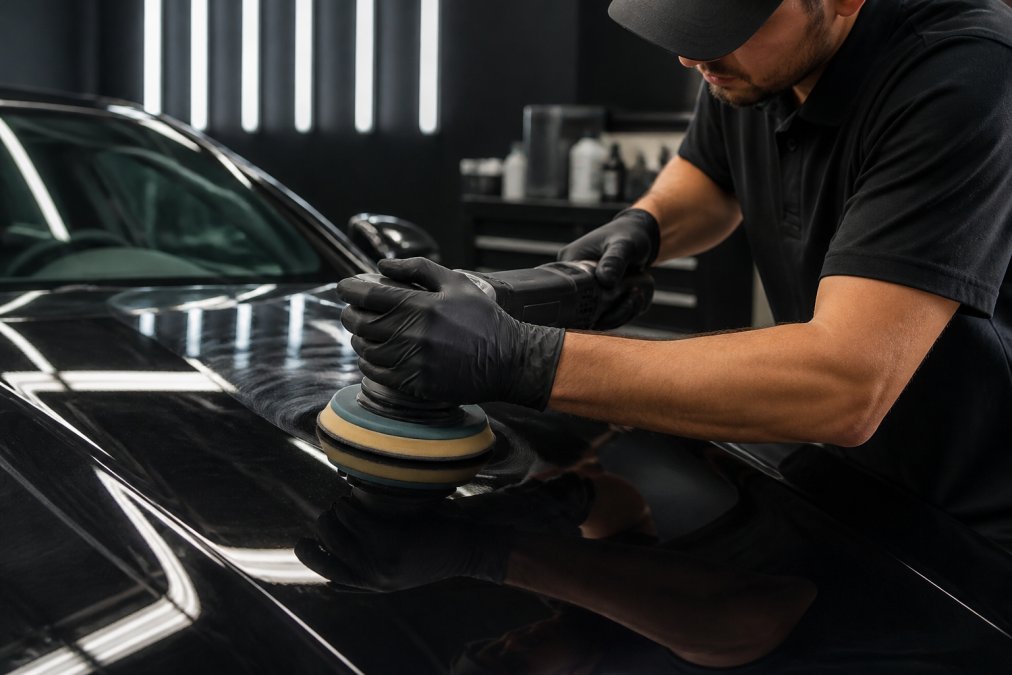
Paint correction is the process of removing swirl marks, scratches, and oxidation from your clear coat before any coating goes on. It is the most labor-intensive part of the job. A coating locks in whatever is underneath it, so the paint must be flawless first.
Skipping this step is the single biggest mistake in DIY coating jobs. The coating hides nothing. It magnifies every defect.
Decontamination and Clay Bar Treatment
Decontamination removes bonded contaminants that washing cannot touch. A clay bar treatment pulls out embedded metal particles, tar, and industrial fallout. Skipping this leaves grit under the coating.
A common mistake is assuming a normal wash is enough. It is not. Bonded contaminants sit inside the clear coat and only a proper decontamination process removes them.
Multi-Stage Polishing and Paint Thickness
Multi-stage polishing uses different pads and polishing compounds to level the clear coat. A paint depth gauge measures paint thickness before and after. This protects you from over-polishing, which can burn through the clear coat permanently.
Most DIY kits do not include this step. That is a big part of why professional ceramic coating costs more.
Professional Ceramic Coating vs DIY Kits: The Real Difference
The main difference between professional ceramic coating and DIY kits comes down to SiO2 concentration, the carrier chemistry, and application technique. Consumer-grade kits are diluted and formulated for forgiveness. Professional-grade coatings are stronger, cure harder, and require training to apply correctly, which is exactly why they cost more and why they are not sold to the general public.
SiO2 Concentration and Chemical Quality
SiO2 concentration is the amount of silicon dioxide in the coating. Higher concentrations generally mean better hydrophobic behavior and longer durability, but concentration alone is not the whole story. The carrier matters just as much.
Consumer kits are typically water-based or low-solvent formulas.
The True Cost of DIY Failure
The true cost of a failed DIY coating is not the kit price. It is the cost to undo the damage and start over. Walk through the common failure modes:
- High spots and streaks, areas where the coating was applied too thick and cured unevenly. They show as dark, glossy patches that will not level out. Removing them means machine polishing that specific area back down to bare clear coat and recoating.
- Trapped moisture or solvent pop, small blisters or cloudiness under the film. The coating has to come off entirely.
- Uneven coverage, thin spots that fail early while the rest of the panel still beads water. The whole panel usually has to be redone so the finish is consistent.
- Contamination under the film, dust, polish residue, or fingerprints locked in. Same outcome: strip and redo.
| Factor | Professional Coating | DIY Kit |
|---|---|---|
| Surface prep | Full multi-stage paint correction | Often skipped or minimal |
| Product strength | Professional-grade, often solvent-based | Consumer-grade, diluted for forgiveness |
| Application setting | Climate-controlled, filtered bay | Home garage or driveway |
| Working time | Short, requires trained technique | Long, forgiving for beginners |
| Warranty coverage | Usually included, in writing | None |
| Risk of failure | Low | Higher, with expensive remediation |
| Cost if it goes wrong | Covered by warranty | Full strip, polish, and recoat at your expense |
How Long Does Professional Ceramic Coating Last?
A professional ceramic coating typically lasts several years with proper care, while DIY kits often fall short of their claims. Longevity depends on the product, the prep work, and how you maintain the car afterward.
Durability, Warranty Coverage, and Curing Time
Curing time is the period after application when the coating hardens and bonds to the paint. During curing, the vehicle must stay dry and away from contaminants. This is why a professional job takes days, not hours.
The Hidden Costs: Facility Overhead and Environmental Requirements
Facility overhead is the cost most customers never see, and it is the single biggest reason a legitimate shop cannot match a mobile detailer's price. A proper coating bay is not a garage with a space heater. It is a controlled environment that has to hold specific conditions for the entire cure window, and running that space costs money every single day whether a car is in it or not.
Climate-Controlled Environment and Specialized Equipment
Most professional-grade coatings specify a cure window with a defined temperature and humidity range. If the air is too humid, moisture can interfere with the bond and leave cloudiness or hazing. If it is too cold, the coating may not cross-link properly and durability drops. If it is too hot, the solvent flashes too fast and you get high spots the applicator cannot level out.
The equipment list is not cheap either:
- Paint depth gauge, measures clear coat thickness before and after polishing so the technician knows how much material is safe to remove
- Dual-action polisher and a full pad and compound range, different paints and defect types need different combinations
- Color-corrected, high-CRI lighting, reveals swirls and defects that ordinary shop lights hide
- IR curing lamps, used to accelerate and stabilize the cure in a controlled way
- Deionized or filtered water, prevents mineral spotting during the prep wash
Chemical Waste and Disposal Costs
Chemical waste and disposal costs are real, and they are one of the clearest dividing lines between a legitimate operation and a hobbyist working out of a garage.
Risk Mitigation: Insurance, Liability, and Why Cheap Coatings Cost More
Professional ceramic coating costs more because it includes accountability. The shop stands behind the work.
Frequently Asked Questions
Why do people charge so much for ceramic coating?
The price reflects extensive prep work, high-quality materials, and professional overhead. Before applying a coating, a shop must decontaminate, clay bar, and polish the paint to remove swirl marks and ensure proper bonding. Professional-grade coatings contain higher SiO2 concentrations and last years longer than consumer kits. Additionally, insurance, climate-controlled facilities, and trained labor all add to the cost. You're paying for durability, warranty coverage, and a finish that protects your vehicle's value.
Is professional ceramic coating worth the money?
For many vehicle owners, yes. A professional coating provides years of protection against UV rays, chemicals, and minor scratches, while making washing easier. It preserves paint thickness and resale value. DIY kits often fail within months due to improper application or low-quality formulas. If you plan to keep your car long-term or own a luxury vehicle, the investment in professional ceramic coating typically outweighs the initial savings of a DIY approach.
How does professional paint correction impact the total price of ceramic coating?
Paint correction is often the most labor-intensive part of the process. It involves multiple stages of polishing to remove imperfections, which can take 10 to 20 hours depending on the vehicle's condition. This step is critical because a coating locks in the surface it's applied to. Skipping or cutting corners on correction leads to a poor finish. The cost of paint correction reflects the skill, time, and specialized equipment required to achieve a flawless surface.
What is the difference between professional-grade coatings and consumer kits?
Professional-grade coatings typically contain a higher concentration of SiO2, the active ingredient that provides hardness and hydrophobic properties. They also have longer curing times and require application in a climate-controlled environment to avoid contamination. Consumer kits are formulated for ease of use, often with lower solids content and shorter durability. Professionals also offer warranty coverage and stand behind their work, which consumer products rarely do.
Choosing a ceramic coating provider is a decision about trust as much as price. A low quote often hides skipped prep, weaker products, and no warranty, and those shortcuts cost you later. At Platinum Auto Works, we pair over 20 years of experience with a state-of-the-art, climate-controlled facility, so every coating is applied with precision and backed by real craftsmanship. Request a quote and protect your investment the right way.