 blog
blog
Ceramic Coating vs Wax for Protection: 2026 Guide
Table of Contents
- Ceramic Coating vs Wax for Protection: Side-by-Side Comparison
- Ceramic Coating Longevity and What Affects It
- The Cost of Professional Ceramic Coating vs DIY Waxing
- How to Maintain Ceramic Coating and Waxed Surfaces
- UV Protection, Chemical Resistance, and Gloss Compared
- Layering, Removal, and Climate Considerations
- Which Paint Protection Fits Your Vehicle and Budget?
- Conclusion
- Frequently Asked Questions
Last Updated: September 25, 2026
Ceramic Coating vs Wax for Protection: Side-by-Side Comparison
Ceramic coating vs wax for protection comes down to a simple trade: wax delivers short-term gloss at a low cost, while a ceramic coating bonds to your clear coat and holds up for years. The catch is preparation and price. A coating demands paint correction first, and it is far less forgiving of a dirty surface. This guide from Platinum Auto Works LLC breaks down durability, cost, maintenance, and climate fit so you can pick the right layer for your vehicle.
How the Two Protection Types Differ
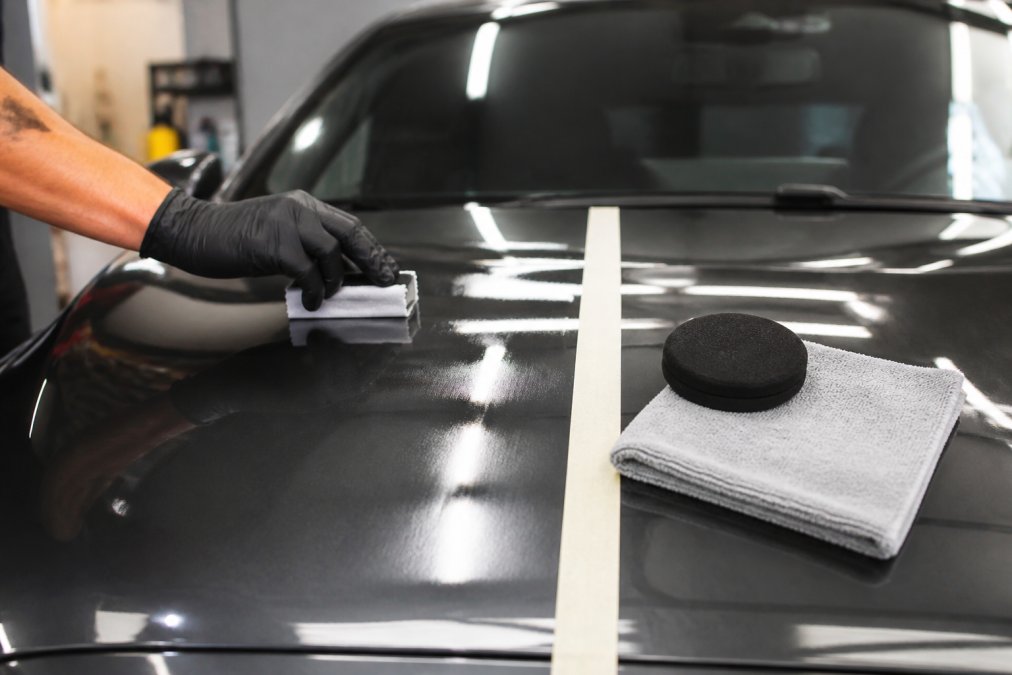
Carnauba wax is a natural product harvested from the leaves of the Brazilian carnauba palm, blended with oils and solvents so it can be spread thin across paint. It sits on top of your clear coat as a sacrificial layer and washes away over weeks.
Ceramic coating is a liquid polymer, usually silica-based, that cures into a semi-permanent film. It cross-links with the clear coat rather than resting on it. That bonding is why a coating resists chemicals, UV radiation, and contaminants far longer than wax.
The practical difference shows up in how water behaves. A coated or waxed surface is hydrophobic, so water beads and rolls off. On a coating, that beading lasts for years. On wax, it fades within weeks.
Ceramic Coating Longevity and What Affects It
Expect a professional ceramic coating to last two to five years, while wax typically holds up for four to eight weeks. Real-world life depends on how the vehicle is stored, washed, and driven.
A few factors move the needle most:
- Surface preparation: A coating applied over swirl marks, oxidation, or bonded contaminants fails early. Paint correction and a clay bar pass come first.
- Curing time: Most coatings need 24 hours or more of dry, dust-free conditions to fully cure. Rushing this step shortens the coating's life.
- Washing habits: Abrasive brushes and automatic washes wear down any sacrificial layer, coated or waxed.
- Parking: A garage-kept car holds its protection longer than one parked under trees or near the coast.
The Cost of Professional Ceramic Coating vs DIY Waxing
Cost is where the two options diverge most, and where most guides stay vague. Here is a concrete framework instead of a single number, because pricing swings widely with vehicle size, paint condition, and how much correction the job needs.
What drives the coating quote
- Paint correction stage. A one-step polish on a new car is far cheaper than a multi-stage correction on a swirled, oxidized finish. Correction is usually the largest line item.
- Coating tier. Entry-level consumer-grade coatings, mid-tier pro coatings, and high-solids multi-layer systems carry different product costs and different advertised lifespans.
- Vehicle size and panel count. A compact coupe takes less product and less labor than a full-size SUV or a truck with a long bed and roof.
- Prep extras. Clay bar decontamination, iron removal, and trim/glass coating add-ons raise the total.
- Facility and curing. A climate-controlled bay with proper lighting and dust control costs more to operate than a driveway job, and that shows up in the quote.
Get a written, itemized quote rather than a phone number.
What wax actually costs you
Wax looks cheap per tin, but the real cost is time and repetition. A quality carnauba paste or liquid wax runs a modest one-time product cost, and one container can cover many applications. The recurring expense is labor: a proper wash, dry, and wax session takes a couple of hours, and you repeat it every four to eight weeks to keep protection alive. Over a three- to five-year ownership window, that is dozens of sessions.
Total cost of ownership, not sticker price
| Factor | Ceramic Coating | Carnauba Wax |
|---|---|---|
| Upfront cost | High (prep + product + labor) | Low (product only if DIY) |
| Recurring cost | Low (maintenance washes, occasional topper) | High (product + your time every few weeks) |
| Time per year | A few maintenance washes | Many wash-and-wax cycles |
| Best value when | You keep the car 3+ years and want low upkeep | You enjoy detailing and keep upfront spend low |
The honest comparison is total cost of ownership across the years you plan to keep the car, not the price of one application against the price of one tin.
At Platinum Auto Works, we quote coating work only after inspecting your paint in person, because a heavily oxidized finish needs more prep than a new one, and that difference belongs in the number you see.
How to Maintain Ceramic Coating and Waxed Surfaces
Maintenance is where coated and waxed cars diverge fast. A coating needs less frequent attention, but it still needs the right kind.
For a coated vehicle:
- Wash every two to four weeks with a pH-neutral soap
- Use the two-bucket method and a soft microfiber mitt
- Skip automatic brush washes entirely
- Apply a coating-specific maintenance spray every few months
For a waxed vehicle, add a reapplication every four to eight weeks and a clay bar treatment when the surface feels rough. Mineral deposits from sprinklers and bird droppings should come off quickly on either surface. Left sitting, they etch into the clear coat.
UV Protection, Chemical Resistance, and Gloss Compared
These three properties are usually lumped together as 'the coating wins.' The mechanism matters more than the verdict, because it tells you when wax is actually the smarter pick.
UV protection
Clear coat is a polymer film, and ultraviolet radiation breaks its chemical bonds over time, which shows up as fading, chalking, and oxidation. A ceramic coating's silica-based matrix is largely transparent to visible light but absorbs and scatters a meaningful share of UV, acting as a sacrificial screen over the clear coat. Carnauba wax also absorbs some UV, but its film is thin and washes away within weeks, so its protection is intermittent. In a high-sun climate, the coating's continuous barrier is the real advantage, not the peak number on a spec sheet.
Chemical and contaminant resistance
A cured coating is a cross-linked, semi-permanent film with a low surface energy. That low surface energy is why water, bird droppings, tree sap, and road salt struggle to bond to it, and why you get a wider cleaning window before etching begins. Wax is a softer, oil-and-wax film that contaminants can penetrate more easily, and it re-dissolves with detergents and heat. Neither layer makes your car bulletproof: acidic bird droppings and hard-water sprinkler spots can etch clear coat if left long enough on either surface. The coating simply buys you more time.
Gloss and aesthetic finish
This is the most subjective category, and the marketing oversells it.
The angle most guides skip: layering and removal
Layering, Removal, and Climate Considerations
Can you layer the two? Yes, and it is a smart move. A ceramic coating topped with a thin layer of wax gives you the coating's durability with a boost of warm gloss. Do not reverse the order; wax under a coating blocks the bonding you paid for.
Climate changes the recommendation:
| Climate Factor | Ceramic Coating | Carnauba Wax |
|---|---|---|
| Intense year-round sun | Best fit, blocks UV for years | Reapply often |
| Coastal salt air | Strong contaminant resistance | Fades quickly |
| Heavy winter road salt | Holds up well | Washes away fast |
| Garage-kept show car | Excellent, long-lasting | Fine for occasional use |
| Tight budget, minimal driving | Higher upfront cost | Low entry cost |
Which Paint Protection Fits Your Vehicle and Budget?
Platinum Auto Works uses a climate-controlled facility and vehicle-specific products, so prep and curing happen in the conditions a coating actually needs.
Conclusion
Choosing between a ceramic coating and wax is really a question about how you use your car and how much upkeep you want to take on. Wax rewards attention; a coating rewards preparation and patience. Either way, the surface underneath decides the final result.
Frequently Asked Questions
Does ceramic coating protect better than wax?
Ceramic coating forms a semi-permanent bond with your clear coat that resists UV radiation, chemical stains, and environmental fallout far longer than wax. A professional coating can last several years with proper care, while carnauba wax typically breaks down within weeks to a few months. Wax still works well as a short-term option, but ceramic coating offers stronger, longer-lasting protection for daily drivers and vehicles parked outdoors.
Is there a downside to ceramic coating?
The main downsides are higher upfront cost and the paint correction required before application, since a coating locks in whatever is underneath it. It also needs periodic maintenance washes with pH-neutral products to keep its hydrophobic properties working. Improper application or skipping surface preparation can lead to uneven gloss or premature failure, which is why professional installation matters.
How long does ceramic coating last compared to wax?
Ceramic coating longevity ranges from two to five years depending on the product, climate, and how the vehicle is stored and washed. Wax, by contrast, usually lasts four to twelve weeks. Vehicles parked outside in intense sun or exposed to road salt will see both options degrade faster, so regular maintenance washes and occasional booster applications help extend either finish.
Is there anything better than ceramic coating for paint protection?
Paint protection film (PPF) offers the highest level of physical defense against rock chips and scratches, and it can be topped with ceramic coating for added chemical and UV resistance. Ceramic coating alone is excellent for gloss and contaminant resistance but will not stop impact damage. Many owners combine PPF on high-risk areas with a coating on the rest of the vehicle for balanced coverage.