 blog
Custom Audio System Upgrades for Cars: A Complete Guide
Table of Contents
- Why Custom Audio System Upgrades Matter
- Factory Speakers vs. Component Speakers: Where to Start
- Car Audio Sound Deadening Installation: The Foundation
- How to Improve Car Audio Without Replacing Head Unit
- Car Audio Amplifier Installation Cost and Benefits
- Integration, Tuning, and EV-Specific Considerations
- Common Installation Mistakes and How to Avoid Them
- Frequently Asked Questions
Last Updated: September 27, 2026
Why Custom Audio System Upgrades Matter
Factory audio systems are engineered for cost, not sound quality, resulting in tinny speakers, shallow bass, and flat soundstage.
Custom audio system upgrades address speaker quality, amplification, sound deadening, and system integration to deliver noticeably better clarity, depth, and detail.
A client with a 2022 luxury sedan discovered layers in his favorite albums after upgrading to component speakers and adding a subwoofer, the difference between factory audio and a thoughtfully designed system.
Entry-level custom audio system upgrades with new speakers and sound deadening deliver noticeable improvements within days, while full rebuilds with amplifiers and DSP processors cost more.
Factory Speakers vs. Component Speakers: Where to Start
Factory systems use coaxial speakers (tweeter and woofer in one unit), which sound compressed and lack detail. Custom audio system upgrades typically start by choosing component speakers instead.
Component speakers separate the tweeter from the woofer, allowing each to handle its intended frequency range without distortion, resulting in wider frequency response and better soundstage.
Why component speakers matter:
- Tweeters mount in optimal locations (often the dashboard or pillars)
- Woofers occupy factory speaker locations with proper mounting depth
- Crossovers prevent each driver from playing frequencies it can't handle cleanly
- Sound stage becomes three-dimensional instead of flat
Upgrading factory speakers is the single best entry point for custom audio system upgrades, voices sound clearer, instruments separate, and bass doesn't muddy the midrange.
Component speakers require custom mounting brackets, wiring runs, and sometimes dash modifications. Professional installation prevents wasted potential from poor tweeter mounting or improper crossover tuning.
Car Audio Sound Deadening Installation: The Foundation
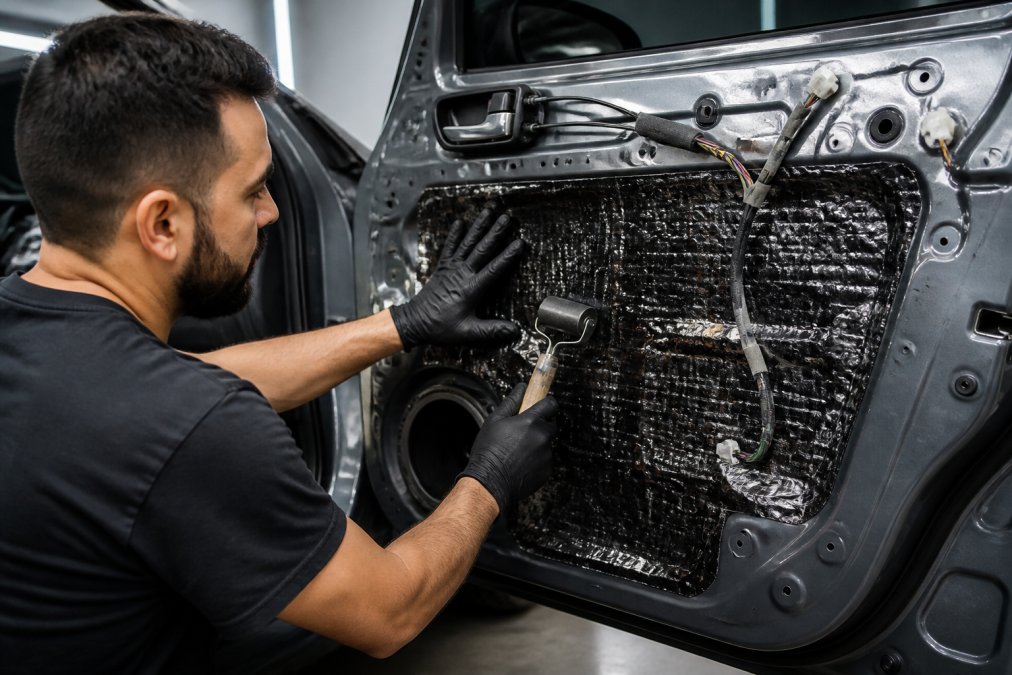
Sound deadening material stops vibrations from sheet metal panels that resonate and color the audio signal. Factory cars have minimal deadening, allowing doors, floor, and roof panels to vibrate freely and absorb bass energy.
Car audio sound deadening installation uses butyl rubber or asphalt-based materials to convert vibration energy into heat, making doors rigid structures instead of sounding boards.
What improves with sound deadening:
- Bass response becomes tighter and more controlled
- Cabin noise decreases noticeably
- Midrange clarity increases (less panel resonance coloring the signal)
- Overall sound stage feels more spacious
Most installations focus on doors, floor, and trunk. Doors matter most because they house speakers and need stable mounting surfaces to prevent panel vibration at audio frequencies.
Professional installation ensures complete coverage without gaps. Incomplete deadening creates dead zones where vibrations still occur.
How to Improve Car Audio Without Replacing Head Unit
Not every upgrade requires replacing your factory head unit, but the decision depends on what it can do and whether smartphone integration matters.
If your car has a modern infotainment system you like, use a line output converter to extract audio signals from the factory unit. Most modern head units output through amplifier inputs rather than RCA cables. A converter taps into those signals at low voltage, preserving quality while allowing external amplifiers and processors.
Improvements without a new head unit:
- Add an external amplifier for more power and cleaner signal
- Install a DSP processor to tune frequency response and time alignment
- Upgrade speakers while keeping factory controls and integration
- Maintain steering wheel controls and factory displays
If your factory head unit lacks CarPlay or Android Auto support, replacing it with an aftermarket unit becomes a primary upgrade. An aftermarket head unit with full CarPlay and Android Auto support modernizes an older vehicle, giving you wireless smartphone mirroring, voice control, and access to modern navigation apps. This often justifies the entire custom audio project by solving usability first, then enabling audio quality improvements.
Head unit replacement makes sense if your factory system lacks CarPlay/Android Auto, predates integration (typically pre-2015), has a proprietary interface, or requires USB instead of wireless connectivity.
Replacing the head unit unlocks better EQ controls, integration with aftermarket amplifiers and DSP processors, subwoofer integration with proper crossover tuning, and real control over sound character.
Factory head units have fixed EQ curves and limited tuning. If your factory system integrates seamlessly with your smartphone and supports wireless CarPlay or Android Auto, a line output converter improves audio quality without losing functionality.
Professional installation prevents ground loop issues or noise that can ruin the upgrade by integrating hardware cleanly into your vehicle's electrical architecture.
Car Audio Amplifier Installation Cost and Benefits
An amplifier provides clean power to speakers. Factory amplifiers deliver 10-20 watts per channel; aftermarket amplifiers deliver 50-150 watts per channel or more.
More power means cleaner sound at higher volumes, dedicated power per speaker, improved dynamics, snappier transients, and better handling of complex passages.
Benefits of a dedicated amplifier:
- Cleaner signal with lower distortion
- Better dynamics and impact
- Ability to add a subwoofer without compromising midrange power
- System stays clean even at high volumes
- Longer lifespan for speakers (less strain)
The trade-off is installation complexity and cost. An amplifier requires power wiring from the battery, ground connections, remote turn-on wiring, and RCA signal cables. Professional installation ensures proper grounding and prevents alternator whine, a high-pitched noise that occurs when the amplifier picks up electrical interference from the charging system.
A subwoofer enclosure is often paired with an amplifier. Subwoofers need more power than factory head units can provide. A dedicated amplifier lets you add deep bass without compromising the rest of the system.
Integration, Tuning, and EV-Specific Considerations
Modern custom audio system upgrades require careful integration with factory systems, especially in luxury and electric vehicles. Integration means ensuring your new components work seamlessly with existing technology, infotainment displays, steering wheel controls, climate systems, and safety features.
A digital signal processor (DSP) is the bridge between factory integration and custom sound quality. A DSP processes audio signals, adjusting frequency response, time alignment, and crossover points. It also handles integration, converting factory audio outputs into clean signals for aftermarket amplifiers.
EV-specific audio challenges:
- Regenerative braking systems create electrical noise
- Quieter cabins expose audio quality issues and electrical noise more clearly
- High-voltage battery systems require careful grounding
- Many EVs have sophisticated factory audio systems that resist aftermarket integration
Electric vehicles present unique opportunities and challenges. The quiet cabin means your audio system will sound noticeably better, or noticeably worse if not installed properly. A poorly grounded amplifier in an EV becomes obvious because there's no engine noise to mask electrical interference.
Time alignment is critical in quiet cabins. This feature adjusts the delay of each speaker so sound arrives at the listening position simultaneously. Without it, the soundstage feels off-center even in a perfectly deadened car. A DSP makes time alignment possible.
The climate-controlled facility allows technicians to test systems thoroughly before and after installation, ensuring electrical noise is eliminated and tuning is precise.
Common Installation Mistakes and How to Avoid Them
Professional installation prevents mistakes that ruin otherwise good upgrades. But understanding what can go wrong, and how to diagnose it, helps you evaluate installer quality and troubleshoot issues after installation.
Ground connection issues create alternator whine or ground loop hum. Amplifiers need a solid ground connection to the chassis, not to a plastic trim piece or paint. Proper installation uses a dedicated ground cable to a clean metal surface, often the battery negative terminal. A poor ground introduces noise that no amount of EQ adjustment fixes.
How to diagnose: If you hear a high-pitched whine that increases with engine RPM, the ground is likely the culprit. Turn off the amplifier and listen for the whine through the speakers, if it persists, the problem is upstream (factory head unit or converter). If the whine disappears when the amplifier is off, the amplifier's ground is compromised. A qualified installer should re-run the ground cable to bare metal on the chassis, away from plastic fasteners or painted surfaces.
Inadequate power wiring causes amplifier protection circuits to shut down during high-demand passages. The power cable from battery to amplifier must be appropriately sized. Undersized cable creates voltage drop, limiting amplifier output. Proper installation uses a fused power distribution block near the battery and correctly gauged cable throughout.
How to diagnose: If the amplifier shuts off or dims during bass-heavy music, measure the voltage at the amplifier's power input while music is playing. It should stay within 1 volt of battery voltage (typically 13.5-14.5 volts). If it drops below 12 volts during peaks, the power cable is undersized or the battery is weak. A qualified installer will upsize the power cable and verify the battery can supply adequate current.
Improper speaker mounting causes rattle and resonance. Component speakers need rigid mounting brackets designed for your vehicle. Generic brackets allow vibration. Technicians should verify mounting depth, ensure tweeters point toward the listening area, and seal enclosures to prevent air leaks.
How to diagnose: Play music at moderate volume and listen for buzzing or rattling that changes with frequency.
Frequently Asked Questions
What's the cheapest way to improve car audio without spending thousands?
Start with sound deadening material on doors and panels, which reduces road noise and improves speaker clarity at minimal cost. Next, upgrade to quality component speakers and add an external amplifier, these deliver the most noticeable improvement per dollar spent. Skip expensive head unit replacements initially; modern smartphone integration through Bluetooth often works well enough. Focus on one system at a time rather than overhauling everything at once.
Should I replace my speakers or head unit first when upgrading my car audio system?
Replace speakers first. Factory head units work fine with aftermarket speakers, and you'll hear an immediate difference in clarity and sound stage. A new head unit without upgraded speakers wastes its potential. Only upgrade your head unit after speakers are in place, or if you need specific features like smartphone integration or digital signal processor (DSP) control that your factory unit lacks.
How does car audio sound deadening installation improve sound quality?
Sound deadening material reduces vibration in doors and panels, which eliminates unwanted resonance that masks mid-bass and tweeter detail. It also lowers road and wind noise, allowing you to hear your music at lower volumes while enjoying better clarity. This is why professional installers prioritize deadening before adding amplifiers or subwoofers, it maximizes the performance of every component you install.
What should I know about electric vehicle audio upgrades?
EVs have unique challenges: their quieter cabins expose audio flaws more readily, and high-voltage battery systems require specialized wiring knowledge to avoid interference. Ground loop and alternator whine issues are less common in EVs, but signal-to-noise ratio becomes more critical. Work with installers experienced in EV integration to ensure your amplifier and wiring harness don't interfere with battery management systems or regenerative braking.